Epstein File EFTA00000252.pdf 2026
Description
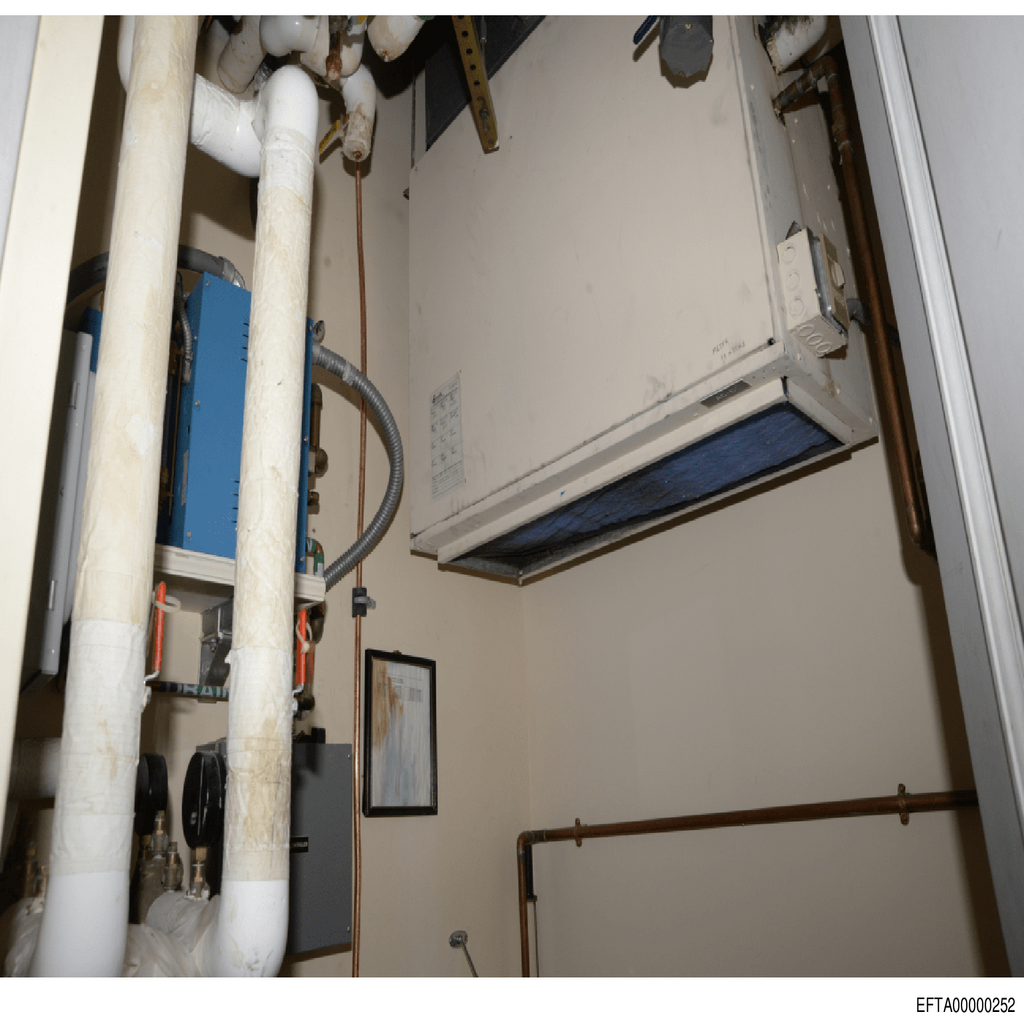
The image showcases a compact mechanical room or utility space that captures a variety of mechanical equipment, piping, and electrical elements, all positioned closely together within a limited area. Central to the image is a prominent wall-mounted air conditioning unit, characterized by a beige exterior that displays some wear, suggesting its operational history. The air conditioning unit features a slatted grille at its base, which indicates the airflow mechanism and houses a blue filter that appears slightly dusty, hinting at the need for maintenance. Adjacent to this unit is a blue mechanical device, possibly a control panel or HVAC component, connected to numerous pipes and ducts that weave throughout the confined space. These pipes are primarily white and exhibit tape around their bases, which implies insulation intended to improve thermal efficiency and prevent condensation. Some of these pipes appear to be made of plastic, while others are metallic, creating a contrast in materials within the narrow confines of the room. A copper pipe runs vertically along the wall and connects to the suspended air conditioning unit, while a horizontal copper pipe is also evident, showing various connections and bends indicative of a complex system likely used for refrigerant or drainage. Above the air conditioning unit, there is a fixed piece of wall, painted in a pale shade, which adds to the overall monochromatic scheme of the room. Attached to this wall is a framed piece of documentation or blueprint, hinting at technical specifications or operational guidelines relevant to the equipment space. The presence of a small metallic valve and a nearby handle suggests control mechanisms for managing the fluid flow through the piping systems, essential in HVAC operations. This structured yet cluttered arrangement mirrors typical mechanical rooms found in residential or commercial buildings, where space is utilized to accommodate crucial heating, ventilation, and air conditioning systems. The image subtly conveys a narrative of maintenance and operation, with visible signs of wear presenting an authentic glimpse into the practical realities of managing indoor climates within a built environment. The overall ambience is functional and service-oriented, clearly emphasizing the importance of regular upkeep and monitoring necessary to ensure optimal performance of the air conditioning and associated mechanical systems. This atmosphere is further underscored by the subtle shadows cast by the overhead lighting, thus creating a sense of depth and dimensionality, which adds to the technical aesthetic of the environment. The careful integration of different elements—mechanical apparatus, plumbing, and electrical connections—alludes to the collaborative efforts required in constructing and maintaining efficient climate control systems in interior spaces.